03The Circumventricular Sentinel Network
A blood test shows how much of a hormone is present. Its effect also depends on which cells meet it and how they respond, and blood-vessel cells meet the whole mixture of hormones and inflammatory signals first. We asked whether single vessel cells in the adult human hypothalamus carry the parts needed to receive several of these signals at once.
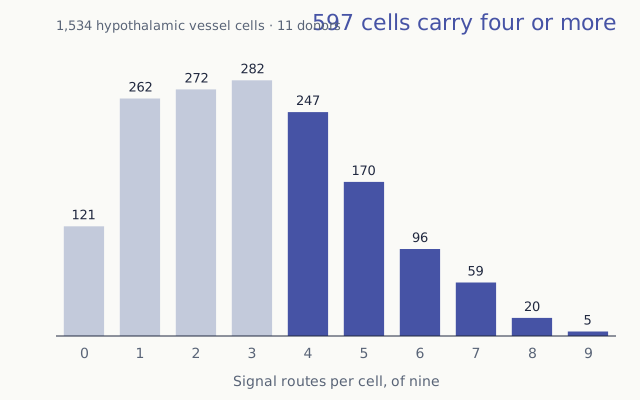
In 1,534 vessel cells from 11 donors, individual cells carried transcripts for up to nine signal routes: leptin, insulin, IGF, thyroid hormone, corticosteroids, sex steroids and three inflammatory cytokines. The combinations were graded, and 597 cells carried four or more. Some pairs, such as the thyroid and sex-steroid routes, occurred together more often than expected once donor and sampling depth were accounted for.
Cells that carried more routes also tended to carry more of the machinery for vessel tone, immune adhesion, transport, hormonal regulation and tissue remodelling. This counts transcripts; it does not measure transport activity. An independent cohort of 20,120 cortical vessel cells from 30 donors reproduced the pattern.
We propose that one signal can change how a second one reaches or acts on the tissue behind the vessel, so the same blood level can produce a different local exposure. At the median eminence, where hormone-releasing nerve endings meet vessels leading to the pituitary gland, that change could reach the wider endocrine response. Experiments in reconstructed human cells will test this, pairing leptin and IGF-1, whose receptors occur together in 436 cells, with a steroid-containing pair that showed the strongest statistical link.
Where the body shares finite energy among competing demands, this interface is one candidate place where its priorities change what tissue receives. It is not proposed as the controller of the whole energy budget.
A change at the vessel wall may also outlast the signal that caused it, by altering how the receiving cells rebuild their receptors. That is the next question this work opens.
Maps how single blood-vessel cells in the human brain are equipped to receive many body signals at once.
In the manifesto: The body has an architecture for setting state
Discuss a partnership