05Sex- and life-stage receiver architecture
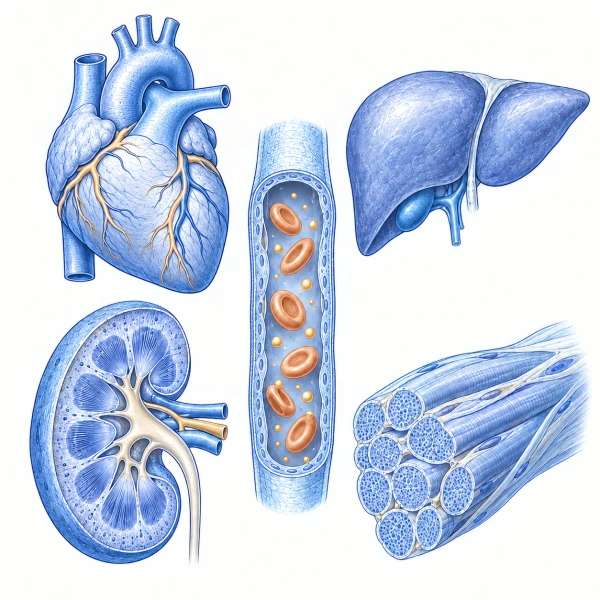
After a meal, several organs share the work. Muscle takes up glucose, the liver releases less of its own, fat tissue holds back its fat, and the pancreas adjusts insulin. Two people can show the same blood glucose while their organs divide that work very differently, and while one of them needs far more insulin to get there.
We call the ability to turn the signals and materials that reach each organ into complementary work, while keeping enough function for the next demand, systemic metabolic readability. Its central claim is that one organ’s response changes what another organ receives. When muscle handles glucose poorly, the pancreas may release more insulin to hold glucose steady. The liver and fat tissue then meet a different insulin exposure, and their response changes the blood again.
This is a different mechanism from competition for energy. Energy-constraint frameworks describe how the body divides a finite budget among competing demands. Here a tissue receives a different hormone, nutrient or timing pattern because another organ changed what entered the blood. We measure the transfer and its energetic and material cost separately.
Present metabolism also builds later responses. The materials that fuel today’s work also build and renew the receptors, membranes and organelles the next signal will need, and that rebuilding can lag behind the meal that used them. A good result now can therefore hide incomplete restoration. A later meal shows which it was: useful preparation, as when breakfast improves the response to lunch, lingering exposure, or failure to rebuild.
An adult-human atlas analysis screened 389 genes, 59 functional modules and 20 route panels across 13 source-region analyses, and yielded 79,927 source-indexed records. It maps where the molecular parts for receiving signals and handling materials are found. It shows where to test function; it does not measure function.
The decisive test changes one organ and predicts the response of the next. In reconstructed human endothelial–muscle and fat–liver systems, we change one operation, measure the signal or material that reaches the second tissue, and replay that exposure on its own. If the replay reproduces the response, the effect was transferred. If a difference remains, the receiving tissue itself contributes.
In patients, the pattern selects the next measurement. More insulin for the same result points to the operation that requires it. Normal secretion with a changed exposure points to clearance or delivery. A normal exposure with a weak response points to the receivers or the work behind them.
Explains how one organ’s work changes what other organs receive, and what they can do at the next demand.
In the manifesto: What reaches the system changes what it can do
Discuss a partnership