
01Reserve Geometry and the Reserve-Setting Cycle
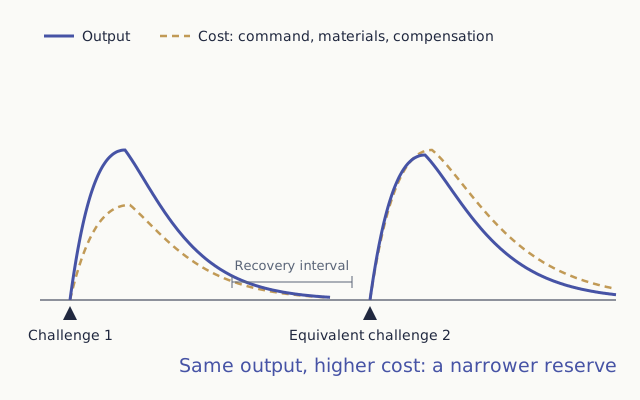
A single test shows how a body responds once. It does not show what that response cost, or whether the body can do it again. Two people can produce the same result while one of them works much harder to reach it, and their next responses can then differ.
Deployable reserve is the capacity to produce a named function under a defined challenge, at a cost that can be read, then clear, rebuild and produce it again under an equivalent later demand.
Our challenge–recovery–rechallenge standard sets out what a claim about reserve must measure: the function, the challenge, the cost, the recovery criterion and the response to the second challenge. Output, hormonal drive, material use and compensating work stay separate measurements. The same output at a higher cost shows a heavier burden, not restored capacity.
Two designs answer different questions. A fixed interval tests the capacity available at a set time after the first challenge. A recovery-triggered design waits until a declared recovery criterion is met and reports how long that took. In both, the decision to rechallenge is a separate safety decision, and a stopped or omitted second challenge stays part of the record.
The paper comes with MDR-Core: protocol templates, a machine-readable record and validation rules, with a worked mixed-meal example. It covers meals, exercise, standing, immune, drug and hormone tests, sleep, and treatment cycles.
Specifies how to measure, in living people, what a body can do again after a demand.
In the manifesto: What should change for patients and clinicians
Discuss a partnership